Automotive Connector with Embedded L-Shaped Pins: Achieving 0.15mm Flatness via Precision Tooling Solutions
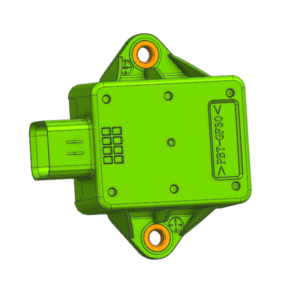
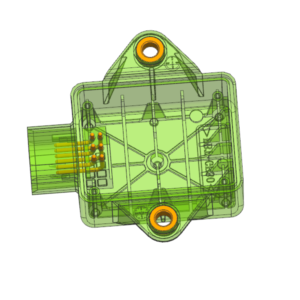
In the manufacturing of automotive electronics and precision connectors, overmolding and insert molding with multi-pin arrays present continuous engineering challenges, particularly regarding warpage control and geometric flatness. Recently, our engineering division successfully developed and mass-produced an automotive precision connector mold with embedded L-shaped pins, strictly maintaining the part’s global flatness within an ultra-tight 0.15mm tolerance limit.
🔍 Customer Challenges & Pain Points
The component’s structural attributes and high glass-fiber loading presented severe technical hurdles:
Anisotropic Shrinkage & Warpage in PBT+30GF Material:
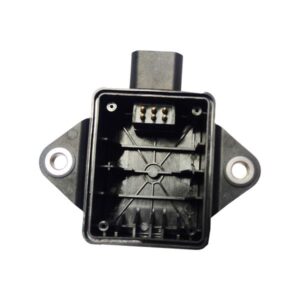
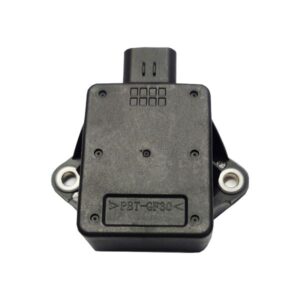
Molded from PBT+30GF (30% glass-fiber reinforced PBT) with dimensions of 80 × 85 × 31 mm, the anisotropic shrinkage along the glass fiber alignment vectors induces severe residual thermal stresses. Standard tooling causes post-molding twisting, making it extremely difficult to achieve the required 0.15mm flatness specification.
L-Pin Positioning Precision vs. Production Cycle Efficiency:
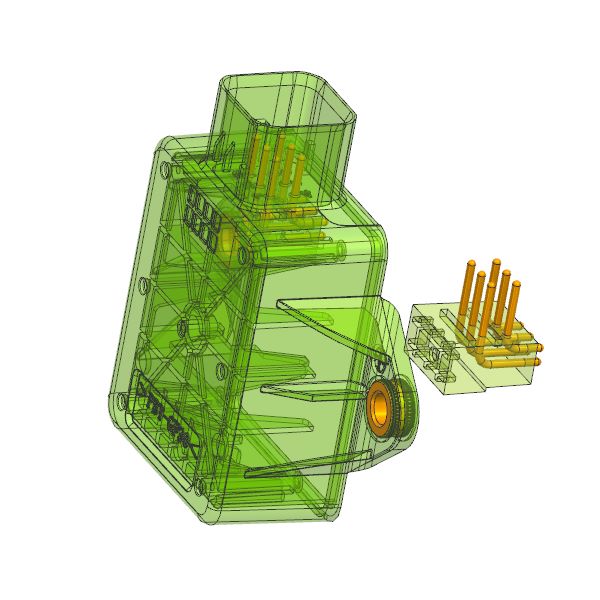
L-shaped metal pins are prone to core deflection, tilt, or displacement under high-velocity melt injection fronts. Furthermore, loading complex L-pin geometries into the tool often expands mold-open cycle times, compromising high-volume production throughput.
⚙️ Our Innovative Mold Solution
To eliminate glass-fiber warpage and guarantee precise insert positioning, our technical team executed a multi-staged tooling framework:
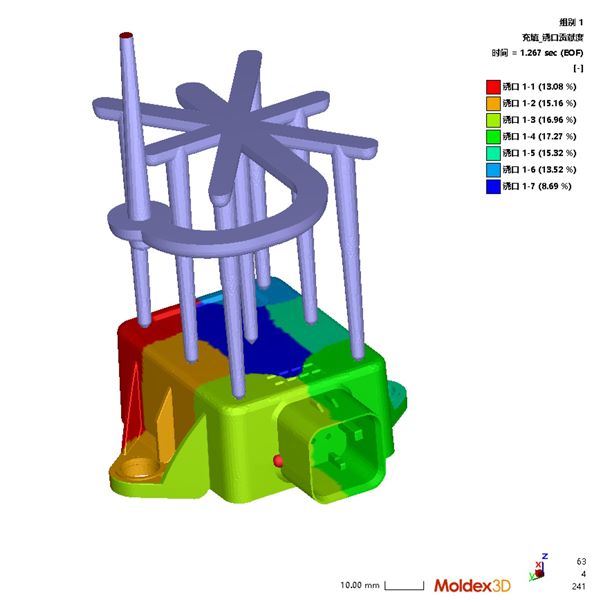
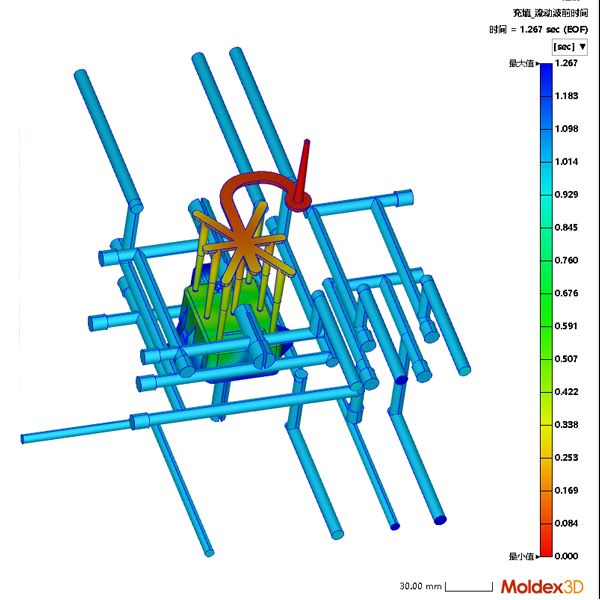
Predictive Moldflow Simulation & Rheological Balancing: Prior to cutting tool steel, we performed non-linear Molding Simulation Analysis to simulate the shear stress profiles and fiber orientation tensors of PBT+30GF. By optimizing the gate location and runner profile, we achieved perfectly balanced cavity filling and neutralized differential shrinkage, preventing warpage at its root cause to lock the 0.15mm flatness tolerance.
Uniform Cooling Channel Circuitry: We designed a highly strategic, multi-zone cooling network that ensures uniform thermal dissipation across both core and cavity plates. This prevents thermal gradients during the solidification phase, providing consistent part shrinkage and locking dimensional repeatability for every production run.
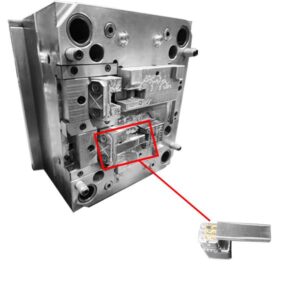
High-Precision Interchangeable Active Insert System: To address the geometric restrictions of pre-loaded L-shaped pins, we engineered custom interchangeable active locating inserts. These inserts feature error-proof mechanical locking to hold the L-pins securely against high injection pressures without deflection, while allowing fast insert swapping to maximize manufacturing efficiency.
🏆 Results & Production Value
Relying on quantitative process modeling and ultra-precision tooling execution, the mold passed full CMM dimensional scanning and cosmetic audits during its T2 trial run, transitioning directly into automated serial mass production. All components met 100% of the automotive technical specifications, earning high client satisfaction.
🌟 Why Choose Us?
Proven Precision Warpage Control: Extensive experience in controlling fiber-filled resin shrinkage (PBT+GF, PA+GF) to maintain strict profile and flatness tolerances below 0.15mm.
Advanced Insert Positioning Tooling: Engineered mechanisms for complex L-pin, U-pin, and threaded inserts, preventing insert shift and damage under injection pressure.
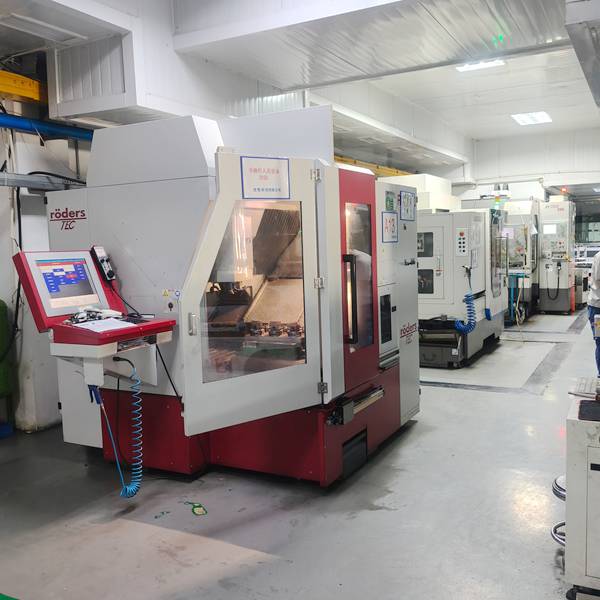
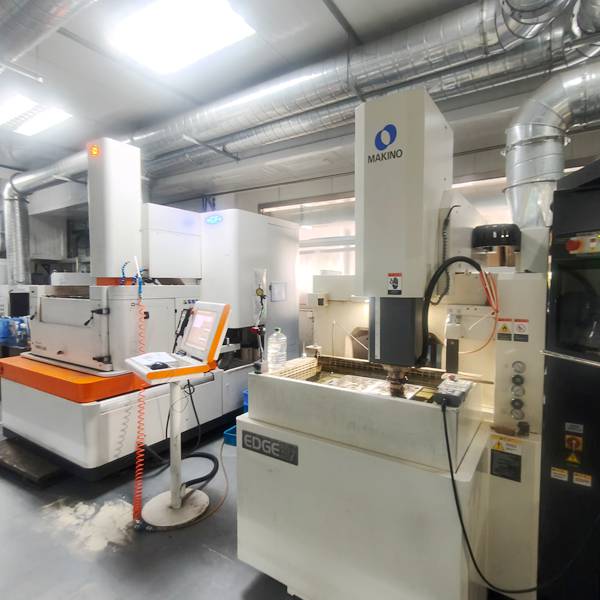
Rapid T2/T1 Tooling Sign-Off: High-precision multi-axis CNC and Mirror EDM machining ensure minimal trial iterations and faster time-to-market for Tier-1 suppliers.