
How TXS Utilizes DFM Simulation, Sub-Micron Tooling, and Digital Fitter Verification to Eliminate Assembly Risks for Global Sourcing Managers
Introduction: The Procurement Challenge of Automotive Seat Components
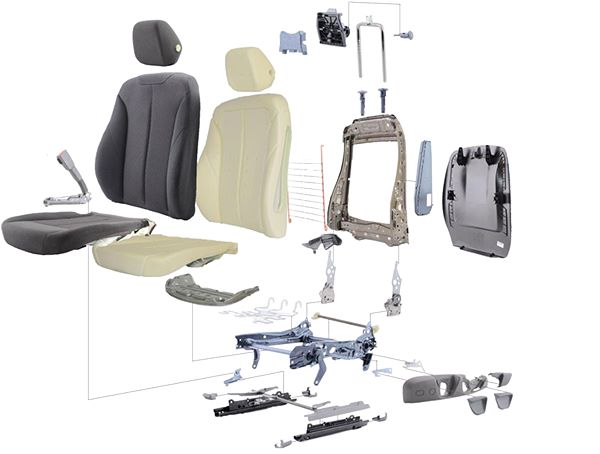
AFor global automotive procurement managers, balancing cost efficiency with precision quality is a continuous challenge—particularly when sourcing structural interior plastic components. Automotive seat frames often feature highly intricate geometries, such as deep ribs, functional clips, and irregular undercuts. These profiles demand exceptional dimensional control and material stability.
In a recent program, a Tier-1 automotive supplier encountered critical defects during the prototype phase of a new seat project. The component, characterized by localized wall thickness variations and precise snap-fits, suffered from severe product warpage and erratic clip tolerances (either too tight or too loose). This resulted in assembly failure and pushed the project timeline into jeopardy. The traditional, trial-and-error approach was consuming excessive tooling budget and failing to secure a stable manufacturing window.
Seeking a reliable plastic mold china partner, the client transferred the project to Tianjin TXS Technology Co., Ltd. (TXS). By implementing a comprehensive, full-cycle technical solution, TXS stabilized mass production from the very first mold trial.
Front-End Engineering – Advanced Moldflow Simulation to Prevent Warpage
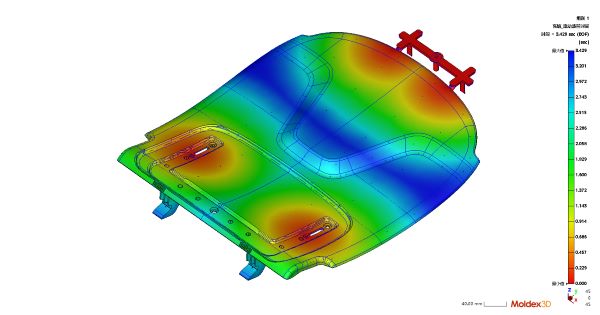
Rather than cutting steel blindly, TXS minimizes tool tuning cycles through rigorous front-end engineering. As an established china mold manufacturer, TXS integrates advanced Moldex3D CAE software at the earliest stage of Design for Manufacturing (DFM) review.
For this specific seat mounting bracket, TXS engineers conducted a comprehensive "Fill + Pack + Warp" simulation to visualize molten plastic behavior, localized shrinkage variations, and cooling thermal stresses. The engineering team performed data-driven optimization across critical processing parameters:
Molding Optimization: Iterative optimization of fill time, flow front temperature, and fill pressure to eliminate weld lines and air traps.
Warpage Control: Volumetric shrinkage was meticulously balanced during the packing phase. By predicting the total displacement of the main body and the snap-fits prior to manufacturing, TXS modified the runner layouts and cooling lines.
This predictive risk mitigation ensured that warpage risks were designed out before tool steel was machined, significantly shortening the development cycle.
Tooling Innovation – Overcoming Complex Geometry with Custom Mold Structures
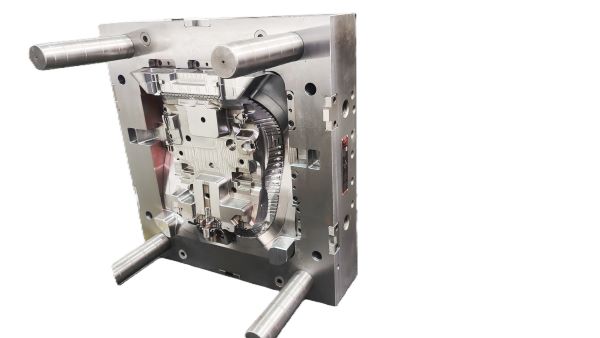
Standard tooling configurations often fail when dealing with deep structural ribs and aggressive, irregular undercuts. As a high-tier china mold factory, the TXS engineering team specializes in non-traditional mold design optimized by CAE analytics.
To release the intricate, irregular undercuts without causing micro-cracks or stress marks on the seat frame, TXS deployed a custom large-angle angled lifter mechanism. In parallel, leveraging the company’s core Digital Fitter Technology, the engineering shop shifted away from traditional, experience-based manual benchwork. By quantifying fitter craftsmanship into repeatable CAD/CAM workflows and digital parameters, TXS guarantees sub-micron tooling replication, eliminating mechanical interferences and boosting first-trial success.
Manufacturing Excellence – Sub-Micron Machining & Automated Molding
To guarantee that the physical tool mirrors the optimized digital model, TXS executes mold fabrication on a world-class machine shop floor equipped with elite machinery:
Precision CNC & EDM: Utilizing Röders high-speed CNC machining centers, Makino mirror EDM machines, and Swiss Agie Charmilles wire-cut EDM, TXS achieves tooling dimensional tolerances within 0.005mm.
Automated Injection Workcells: Mass production is deployed across precision injection presses (50T to 600T) from Sumitomo and Haitian, integrated with automated robotic arms to maintain continuous, flawless cycle times.
Metrology-Backed Quality Assurance – UCF Gauges & CMM Inspection
To ensure flawless field-assembly precision, TXS implements a rigid, multi-tiered quality control matrix that spans from the tooling floor to the final automotive assembly line:
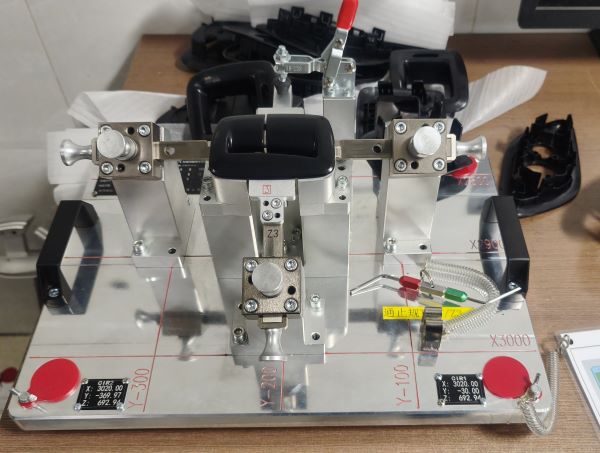
Unit Check Fixture (UCF) Gauges: TXS utilizes specialized UCF interior/exterior combination gauges to simulate the actual vehicle environment. This allows for real-time validation of geometric dimensions, tolerances, and fit precision, preventing assembly line stoppages at the vehicle manufacturer.
Advanced Metrology Lab: Critical tolerances undergo 100% full-dimensional layout inspection using a Swedish Hexagon Coordinate Measuring Machine (CMM), high-precision vision measuring systems, and 3D blue-light scanners.
Traceability: Raw material properties are checked via a Melt Flow Index (MFI) tester, with all process, inspection, and material data uniformally logged for 100% compliant digital traceability.
The Sourcing Result: Measurable Procurement Value
Through strategic collaboration with TXS Technology, the tier-1 supplier eliminated warpage defects and successfully achieved perfect assembly alignment from the very first physical tool run. For global procurement managers, choosing TXS as their mold manufacturer in china delivers true commercial value:
Proactive Risk Management: Front-end CAE simulation eliminates downstream tooling re-work expenses.
Engineered Innovation: Custom lifter mechanics and sub-micron machining resolve tough geometries.
Turnkey Reliability: End-to-end capabilities spanning from initial DFM concept to post-processing (laser etching, ultrasonic welding) and final packaged products.