
In the fields of life sciences and medical diagnostics, the requirements for dimensional tolerance, material purity, and surface finishes on laboratory consumables are exceptionally high. When medical products feature complex micro-structures integrated into everyday consumables, partnering with a highly capable china mold manufacturer is critical to bridging the gap between advanced product design and mass manufacturability.
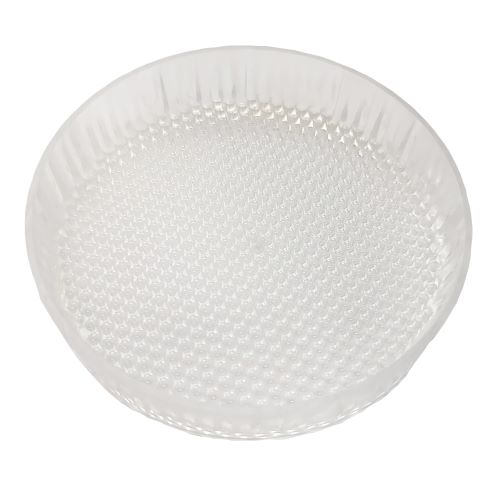
Recently, our engineering team successfully developed a high-precision tooling and molding solution for a complex, medical-grade polycarbonate (PC) culture dish. The part features a Ø92 x 17 mm envelope, demanding an optical mirror finish alongside an integrated micro-structure consisting of over 1,000 built-in honeycomb holes, each separated by a web thickness of just 0.3 mm.

1. Technical Challenge: Thin-Wall Micro-Structures Combined with Optical Mirror Finishes
Manufacturing a multi-cavity tool for this complex geometry with conventional tooling methods poses several significant risks:
- Short Shots & Hesitation: Molding clear polycarbonate (PC) through 0.3 mm micro-channels easily leads to premature freezing, filling hesitation, and incomplete parts.
- Deformation & Ejection Damage: Ejecting thousands of tiny, thin-walled structures without causing distortion or micro-cracks requires extremely precise draft angles and parting-line alignment.
- Optical Clarty Requirements: Maintaining a flawless mirror finish on the mold cavity surfaces while ensuring the structural integrity of the micro-ribs requires top-tier mold finishing capabilities.
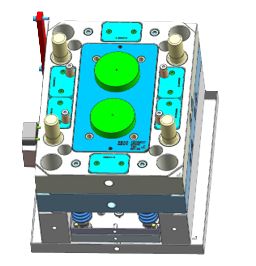
Fulfilling these requirements under a 1x2 cavity layout meant optimizing mold flow, utilizing micro-machining, and executing rigid quality control.2. Custom Engineering & Advanced Tooling Solutions
As an experienced mold maker china, we developed a comprehensive engineering approach from Design for Manufacturability (DFM) through to cleanroom trial molding:
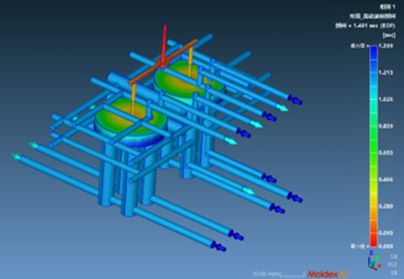
A. Scientific Mold Flow SimulationA. Scientific Mold Flow Simulation
Prior to steel cutting, we conducted detailed mold flow analyses to simulate the melt front behavior of the optical-grade PC resin. By optimizing gate sizing and the runner system, we ensured balanced melt delivery. This simulation eliminated shear-induced material degradation and secured uniform filling pressure across all 1,000+ micro-honeycomb cells.
B. Sub-Micron EDM Tooling & Metrology InspectionB. Sub-Micron EDM Tooling & Metrology Inspection
Replicating the 0.3 mm honeycomb geometry into the hardened mold core demanded ultra-precision machining and rigid quality control:
- High-Precision CNC Machining: We utilized ultra-precision CNC centers to machine copper-tungsten electrodes to tolerances under 0.005 mm.
- 3D Metrology Verification: Every finished electrode was scanned and verified using high-precision optical scanners to ensure 100% geometric conformance prior to EDM.
- Precision Mirror EDM: Using advanced Japanese Makino EDM machines, we executed micro-discharge machining to achieve the critical optical mirror finish on the cavity while perfectly maintaining the sharp corners and clean parting boundaries of the 0.3 mm ribs.
C. High-Repeatability Electric Injection Molding
For the molding phase, production was carried out on fully imported, high-speed Sumitomo electric injection molding machines. The superior injection pressure control, millisecond response times, and highly stable clamping forces of these all-electric machines ensured consistent cavity packing, preventing flash while successfully eliminating short shots in the thin-walled sections.
3. Proven Milestones: Reaching Mass Production at T1
Our technical approach minimized typical mold-tuning iterations, delivering rapid validation and highly stable manufacturing performance:
- T1 Mass Production Approval: Thanks to rigorous simulation and precision machining at our china mold factory, the mold samples from the first trial (T1) met all dimensional, structural, and cosmetic specifications, saving the client up to 60% in traditional development lead times.
- Consistent Yield Performance: During high-volume mass production runs, the First Pass Yield (FPY) for the 0.3 mm ultra-thin honeycomb sections consistently remained above 98.5%.
- Collaborative Innovation: The client, a leading life sciences brand, reported: "This complex design had been rejected by multiple tooling vendors. The team delivered a stable, high-yield tool that allowed us to launch ahead of schedule."
🤝 Partner with a Premium China Mold Company
Whether you are developing complex lab consumables, microfluidic devices, or optical components, partnering with a leading plastic mold china specialist guarantees your technical designs are translated into stable, high-yield mass production.
Contact our technical sales team today to discuss your precision molding requirements.
Email: [email protected]
Website: www.molds-maker.com